
Ducati owners in the UAE should shorten their Ducati service interval Dubai to every 5,000 to 7,500 kilometers to account for extreme temperatures and desert dust. Regular oil changes and cooling system checks are essential for maintaining engine longevity; these proactive measures prevent heat-related wear during the harsh summer months.
Owning a Ducati in Dubai offers an unparalleled riding experience, but the harsh desert climate presents unique challenges that a standard factory manual simply cannot predict. When the mercury hits 50 degrees, your Desmodromic valves and high performance fluids are subjected to thermal stress that exceeds typical European riding conditions. Maintaining the peak mechanical integrity of your machine requires more than just following a generic checklist; it demands a localized approach to maintenance. In this guide, Powershift Motorsports explores how to optimize your Ducati service interval for the UAE. We will examine why extreme heat necessitates more frequent oil changes, how to combat the abrasive effects of fine desert sand on your air filters, and what every rider needs to know about managing critical Desmo milestones under local pressure. By adapting your schedule, you ensure your Ducati remains as sharp and reliable as the day it left the showroom.
Why Dubai Weather Changes Your Ducati Maintenance Schedule
Operating a Ducati in the United Arab Emirates requires a recalibration of how you view the owner's manual. While Borgo Panigale engineers design these machines for peak performance, the factory guidelines are typically calibrated for temperate European climates. In Dubai, motorcycles face a relentless trio of environmental stressors: extreme ambient heat exceeding 50 degrees Celsius, high coastal humidity, and fine airborne sand that penetrates even the tightest seals.
Under these circumstances, your riding profile shifts from standard usage to what is technically classified as severe conditions. Thermal stress is the primary concern. Excessive heat causes oil viscosity to break down faster than anticipated and forces cooling systems to work at their absolute limit. When you combine this with the abrasive nature of desert sand, the standard Ducati service interval Dubai riders see in their manuals becomes a risky benchmark rather than a safe rule.
At Powershift Motorsports in Al Quoz, we treat maintenance as a proactive defense against engine degradation. Our technical team utilizes advanced digital diagnostics to identify early signs of wear that standard inspections might miss. Because the UAE climate accelerates the aging of rubber components and fluids, our specialization in Ducati Desmo services emphasizes precision adjustments tailored to local reality. To ensure your machine remains in peak condition without disrupting your schedule, we coordinate door-to-door vehicle pick-up and drop-off throughout the city. Addressing these environmental factors early prevents the compound damage that leads to costly mechanical failures during the peak riding season.
Standard Factory Guidelines vs. Real World UAE Riding
The Ducati owner’s manual is a masterpiece of engineering documentation, but its service schedules are optimized for a reality that rarely exists on Sheikh Zayed Road. Most modern Ducatis call for an Oil Service every 15,000 km and a major Desmo Service every 30,000 km. While these figures are achievable in temperate European regions, they fail to account for the thermal load of the UAE. In Dubai, a motorcycle frequently operates in a state of stress that factory engineers classify as severe usage.
For high-performance models like the Panigale V4 or the Multistrada V4, adhering to the 15,000 km interval is often a mistake. These high-string engines demand pristine lubrication to manage internal friction. At Powershift Motorsports, we recommend shortening the oil change interval to 5,000 or 7,500 km. This ensures the oil retains its protective properties before the intense heat causes a breakdown in chemical stability.
Service Type | Factory Guideline (Standard) | Recommended Dubai Interval |
|---|---|---|
Oil & Filter Change | 15,000 km / 12 Months | 5,000 – 7,500 km / 6 Months |
Intermediate Inspection | Yearly | Every 6 Months |
Desmo Valve Service | 30,000 km | 24,000 – 30,000 km (Early Inspection) |
Stop-start traffic in areas like Downtown Dubai or Business Bay is particularly punishing. In these environments, the bike suffers from "heat soak." When a motorcycle is stationary in 45 degree weather, it loses the beneficial cooling of high-speed airflow. The engine continues to generate massive amounts of energy, yet the radiator can only dissipate so much heat via the fans. This constant thermal cycling accelerates the aging of gaskets, hoses, and internal fluids.
We utilize advanced digital diagnostics to monitor how these conditions affect your bike’s specific health parameters. Because every rider’s route differs, a personalized approach to the Ducati service interval Dubai riders follow is essential. Our specialization in Ducati Desmo services allows us to identify when a machine has been pushed past its standard limits by the local environment, ensuring we adjust the maintenance plan to match the actual wear on the components rather than just the odometer reading.
Understanding the Ducati Oil Change Interval in 50 Degree Heat
When ambient temperatures hit 50 degrees Celsius, the oil inside a high-revving Ducati engine can easily exceed 120 degrees. This extreme thermal load initiates a process called thermal thinning, where the long-chain polymers responsible for maintaining oil viscosity begin to shear and break down. For riders in the UAE, high-performance synthetic oil is mandatory; its superior molecular stability provides a more consistent protective film than mineral-based alternatives. However, even the most advanced synthetics are not immune to oxidation and additive depletion when subjected to the relentless heat soak of Al Quoz traffic.
Detecting oil degradation requires a keen ear and a sensitive foot. You may notice the gearbox feeling increasingly notchy or finding neutral becoming a chore, as degraded oil fails to facilitate smooth clutch and gear engagement. Similarly, an increase in mechanical clatter from the cylinder heads often indicates that the oil has thinned too much to properly cushion the valve train. Because our specialization in Ducati Desmo services focuses on long-term engine health, we view the mid-interval oil change as the most cost-effective insurance policy available. It is a small investment that guarantees the Ducati service interval Dubai owners adhere to reflects the actual chemical lifespan of their engine’s lifeblood.
The Desmo Service: Critical Milestones for Dubai Riders
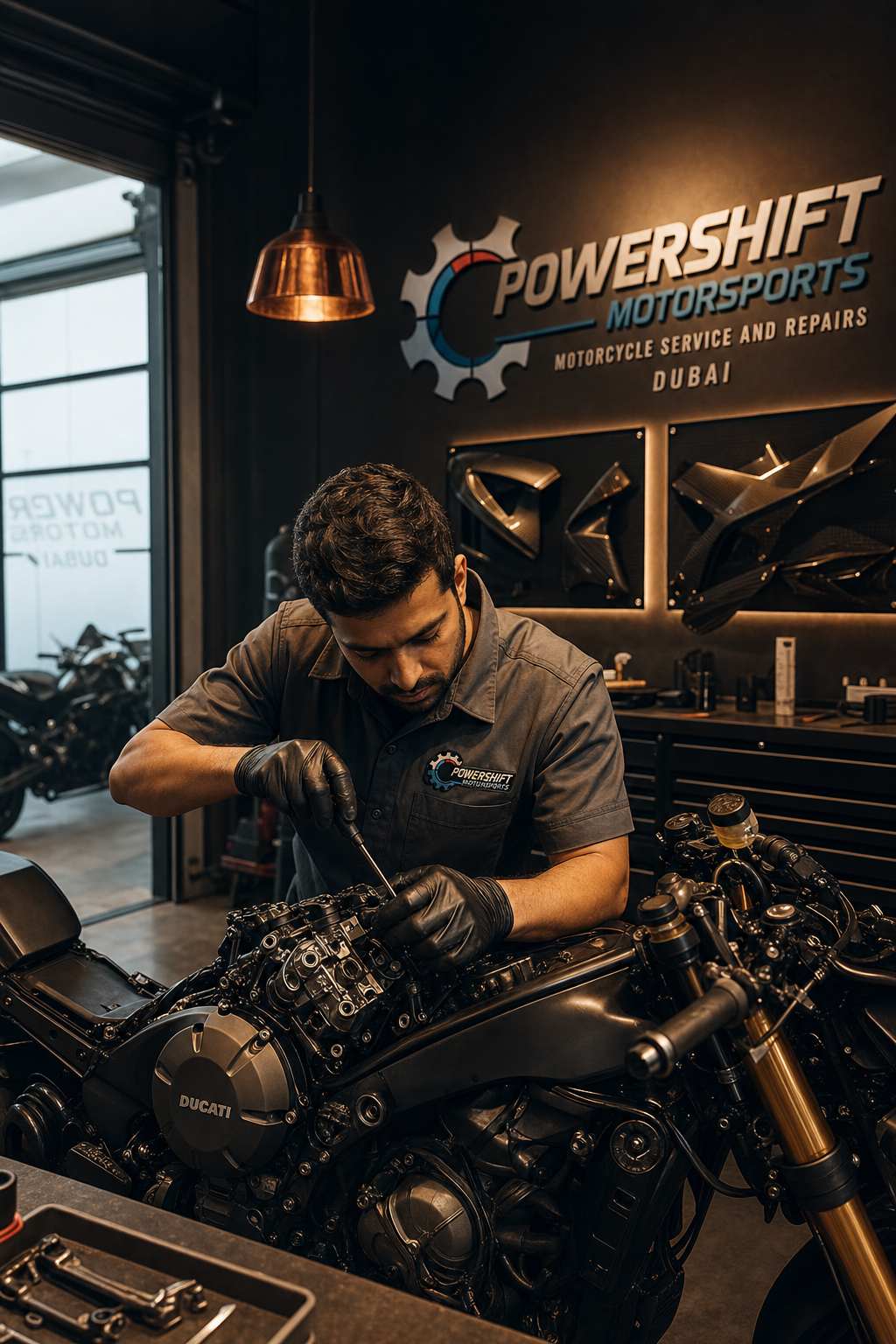
Beyond fluid dynamics, the structural integrity of your valvetrain represents the highest stakes of maintenance. The Desmodromic system, which uses mechanical rockers rather than springs to both open and close the valves, is what gives a Ducati its character and high-RPM reliability. However, this mechanical precision demands zero-tolerance clearances. In the context of a Ducati service interval Dubai riders follow, the Desmo Service is the point where technical mastery becomes non-negotiable.
While the mileage for valve clearance checks on modern Testastretta or Desmosedici Stradale engines is generous, the timing belts that drive them are vulnerable to the UAE climate. These rubber belts are subject to immense thermal cycling. Over time, the extreme ambient heat in Al Quoz and the radiant heat from the engine cause the rubber compounds to harden and lose elasticity. A belt snap is catastrophic; it often results in bent valves and piston damage. We recommend that timing belts be inspected or replaced every two years, or even annually if the bike is ridden heavily during the summer, regardless of the odometer reading.
Our specialization in Ducati Desmo services involves using factory-grade tensioning tools to ensure the belts are set to the exact frequency required for heat expansion. Using advanced digital diagnostics, we monitor engine health and timing accuracy to ensure the valvetrain remains synchronized. Because this service is labor-intensive, we offer door-to-door vehicle pick-up and drop-off to facilitate these critical milestones without requiring you to navigate the midday heat.
Combatting Sand and Dust: Air Filter and Chain Maintenance
While internal mechanical synchronization is paramount, the external environment introduces a relentless, abrasive enemy: fine desert sand. In the Al Quoz industrial area and along desert highway routes, airborne silica acts like liquid sandpaper on moving parts. The standard Ducati service interval Dubai riders follow often underestimates how quickly a high-flow air filter can become choked. A clogged filter forces the engine to work harder, increasing operating temperatures and potentially allowing micro-particulates to bypass the media. We recommend inspecting the air filter every 5,000 km. During our advanced digital diagnostics and routine checks, we often find filters heavily impacted long before the factory-recommended milestone.
The final drive system is equally vulnerable. When sand mixes with traditional wet chain lube, it creates a destructive grinding paste that rapidly eats through O-rings and sprockets. For Dubai riders, chain maintenance requires a specific approach:
Clean: Use a dedicated chain cleaner and a soft brush to remove the sand-laden sludge every 500 to 800 km.
Dry: Ensure the chain is completely dry before applying new lubricant.
Lubricate: Opt for a high-quality dry or wax-based lubricant that resists sand adhesion, rather than a tacky wet spray.
This proactive care, combined with our specialization in Ducati Desmo services, preserves the efficiency and longevity of your drivetrain against the harsh UAE landscape. If your schedule is tight, we can facilitate these inspections through our door-to-door vehicle pick-up and drop-off service.
Brake Fluid and Coolant: Managing Thermal Stress

Managing thermal stress involves more than just engine oil; the hydraulic and cooling systems are your primary defense against performance fade. In Dubai, high coastal humidity presents a specific challenge for brake systems. Glycol-based brake fluid is hygroscopic, meaning it actively absorbs moisture from the air. When the water content in your fluid rises, its boiling point drops significantly. During spirited riding or heavy braking in heavy traffic, this moisture can turn to vapor, causing a dangerous spongy lever feel and reduced stopping power. We recommend a full brake fluid flush every 12 months, utilizing high-boiling-point fluids that exceed factory specifications to ensure consistent feel even when temperatures soar.
Similarly, your cooling system operates at its absolute limit when the ambient temperature approaches 50 degrees. The Ducati service interval Dubai riders follow must prioritize the integrity of the radiator and coolant concentration. Even a thin layer of fine desert dust on the radiator fins can reduce heat exchange efficiency by 20% or more. Our team uses advanced digital diagnostics to monitor operating temperatures and ensure the cooling fans trigger correctly. We advocate for a biennial cooling system flush, using premium coolants formulated specifically for high-performance aluminum engines to prevent internal corrosion and localized boiling. This meticulous approach is part of our specialization in Ducati Desmo services, ensuring your machine remains thermally stable. For those unable to visit our Al Quoz facility, we coordinate door-to-door vehicle pick-up and drop-off to keep your safety systems in peak condition.
The Importance of Summer Storage and Battery Care
When the mercury climbs, many riders opt to park their machines, yet inactivity in a Dubai garage presents its own set of mechanical risks. High ambient temperatures accelerate the self-discharge rate of batteries. Modern Ducatis, equipped with sophisticated electronics and security systems, experience a constant parasitic draw that can lead to a deep discharge if left unattended. Utilizing a dedicated battery tender is essential to maintain the correct voltage and prevent the internal sulfation that often occurs during the summer months.
Tires also suffer from prolonged storage. The combination of sustained pressure and high heat can lead to permanent flat-spotting, compromising handling when you return to the road. We recommend using paddock stands to keep the weight off the rubber. As October approaches, a comprehensive pre-season check-up at our Al Quoz facility is vital. Our specialization in Ducati Desmo services ensures that your machine is transition-ready, while advanced digital diagnostics can detect if dormant sensors or electronic components have been affected by the heat. For maximum convenience, we offer door-to-door vehicle pick-up and drop-off to facilitate these inspections before the peak riding season begins. This final step ensures your Ducati service interval Dubai remains on track despite the seasonal hiatus.